

Artichoke and Olive Oil: The Finer Points of Tasting
From the author’s series “Artichoke and Olive Oil” by Anna Petkova
Source: https://www.bacchus.bg/
For many of us, olive oil tasting is a mystery. The very thought of sipping and evaluating oil (even olive oil) with our nose and palate raises a number of questions and doubts. How can we drink fat, and several different samples at that? What about the calories? And there is hardly much to distinguish in terms of flavors and aromas anyway... These are all wonderings that many course participants quietly ask themselves in their minds when their first olive oil tasting is coming up.
The truth is that for any natural product that is minimally altered in the production process and that comes with its place, climate and specific care, tasting is not only possible but also brings great excitement and satisfaction. It opens new doors to the richness and biodiversity of nature and their significance for life.
Just as we appreciate the flavor and aroma palette of wine, coffee, tea, chocolate, honey, cheese and salt, we can appreciate olive oil too. The steps are similar, with some subtleties that need to be taken into account.
Temperature
The olive oil should be acclimatized to a temperature of 28°C so that its flavors and aromas open up to the maximum and in all their brilliance. This is a requirement for any professional assessment by a tasting panel, and such an assessment is mandatory for the oil to be offered for sale. The same applies to the chemical analysis of the olive oil in a certified olive oil laboratory.
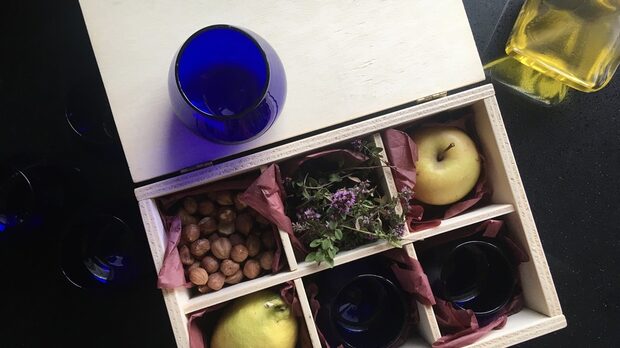
Tasting Glass and Equipment
For the characteristics of an oil to show fully, we use a special tasting glass in cobalt blue or red. The color of the oil is not a characteristic that is assessed and has no bearing on the categorization of its quality. The other important feature of the glass is that its shape, the diameter of the opening, and the thickness of the base and walls are standardized by the IOC (International Olive Council), so that the characteristics of each oil show in the most categorical way. Interestingly, the Italian artist Valerio Marini, who has partnered with Olio Officina for years, sings the praises of the glass in his works dedicated to the olive tree, its fruit and its nectar.
Instructions for the Taster
The taster must be well prepared mentally and physically. Smoking, perfume, hand and face cream, coffee and teas with strong aromas, as well as the consumption of spicy foods and spices are not friends of the true taster who takes the evaluation of the oil seriously. I remember my first meeting with my Italian mentor Maria Paola Gabusi and how she sent me out of the class because of a drop or two of perfume on my wrists - a lesson I remember to this day! This is established etiquette among tasters and an expression of respect for the others in the group, so that they can assess the product calmly and without outside distractions. Concentration and absorption are essential when we determine the nuances on the nose and palate, especially when it comes to complex olive oils and competitions with scales from 1 to 20 for the evaluation of each characteristic.
Flavors and Aromas
The nuances, as you already know, are numerous and multilayered. Knowing natural smells and building an aroma memory is a very valuable asset that always pays off for us as tasters. Our contact with tomatoes on the vine - green or ripe, with legumes still in the pod, which we break open and smell, with leafy greens such as beetroot, chard or sorrel, with fragrant field and mountain herbs - green and flowering, with freshly cut grass and a haystack in July, helps us capture the palette and distinguish the fine notes. And of course, frequently training the senses with olive oils varied in variety, terroir and style is a huge help in developing a vision and a basis for comparison.
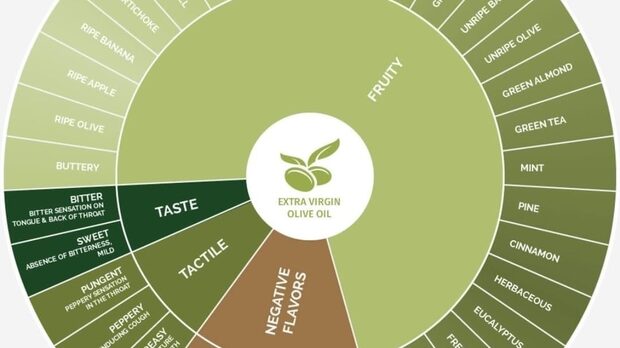
The Tasting Itself: How and What?
Olive oil is definitely captivating and can even exalt with its lavish bouquet of green and ripe, spicy and sweet aromas. And yes, there is no need to worry about drinking the whole contents of the glass, since the fat is noble and does not weigh on the palate, and the body takes it in with ease because of the ethereal nature of oleic fatty acid (Omega 9). In master classes we usually taste 6 extra virgin olive oils x 15 ml in a glass, with the order determined by the intensity of the characteristics fruitiness, bitterness and pungency for the given variety.
It is important to go from delicate through medium to intense levels, in order to calibrate the palate and build up the sensations. I always add an olive oil with defects (often rancid or with the mold/winey-vinegary defect), and so the difference between a good and a mediocre olive oil is obvious, even to beginner tasters. It is advisable to taste before noon, when our senses are still fresh and unburdened by food, drinks and extraneous aromatic impressions.
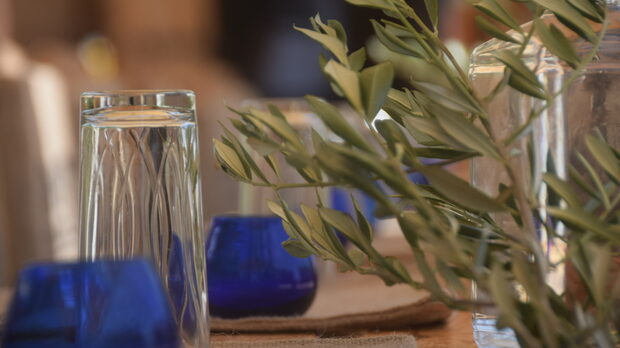
Notice, the next time you taste olive oil, that with the first small sip and spreading it over the tongue comes the bitterness, and after about ten seconds the characteristic pungencyappears, felt in the area of the tonsils. The second sip and drawing in of air, which the Italians call strippaggio, opens up the playfulness and peppery bite of the olive oil, and so it asserts itself with certainty. And if the sip leads to coughing and tears, it is a sure sign that this olive oil is special and has character! Pair it with the right food and the euphoria of every bite is guaranteed.
How Do We Cleanse the Palate?
Between two olive oils we sip water or eat a slice of green apple (usually of the Granny Smith variety) to cleanse the palate and tune it for the next glass. We first warm the glass in the palm for a minute, then remove the lid and smell to distinguish the aromas, and after that we sip once and then a second time with great attention. And imperceptibly the (extra virgin) olive oil captivates us.